
Hello world!
Welcome to our blog. Since I am new to blogging, I will begin by asking for suggestions. Please respond now with a comment with topics of interest to you. I will start discussions based upon the topics suggested.
Thanks,
Gordon P Smith, DDS
What are CEREC One-Visit crowns?
CEREC stands for the Chairside Economical Restoration of Esthetic Ceramics.

This is the CEREC Omnicam
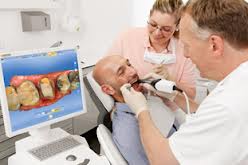
Easy videos of teeth.
But what is it actually?
CEREC Omnicam is innovative equipment that allows our office to use 3D streaming video of your teeth and special software to design a custom crowns, veneers, and fillings in our office. The design is then sent wirelessly to a milling machine in our office and is milled from a solid block of ceramic. Once baked, custom shaded, and polished it is bonded to your tooth. You leave the office within 90 minutes with an exceptionally strong, beautiful custom restoration.
Patients also love the full color virtual models of their mouth produced by Omnican. This technology is excellent for patient education.
Let’s explore some of the advantages of this procedure to you as a patient:
- Eliminates the need for filling your mouth with mushy, unpleasant impression material
- There is no need to wear a temporary crown for weeks which may feel unnatural, come loose, break, or leak leading to tooth sensitivity
- The all ceramic crown is highly esthetic and match your natural teeth unlike the old opaque porcelain to metal crowns
- One-Visit crowns are much more convenient. There can be less drilling, fewer injections , and less time out of your hectic schedule. Rather than taking 2 days off, only a couple of hours may be missed from work. Also, if you are a college student away at school how convenient would it be to only have to make one trip home.
- You as the patient get to see the shape and look of the restoration and provide input before it is completed
- Since your crown design images are saved on the computer a exact duplicate can be made if it does get damaged.
One visit. No impression material. No temporary. Great results. What are you waiting for?!
Obesity and Periodontal Disease (Periodontitis)
Obesity is considered to be low grade systemic inflammation. Fat cells release cytokines similar to those in periodontal disease. These cytokines both directly cause tissue damage and regulate other chemicals that activate body defense mechanisms which cause inflammation. The attached article links obesity to increase risk of periodontal disease. Obesity and Periodontal Disease Article
2nd Take Shape for Life Informational Meeting and Tasting
Jacki and I would like to thank those who made it to the last meeting in January in spite of the snow storm. Those of you who couldn’t make it have another chance.
We will be having a 2nd meeting on Sunday March 6th at 2:00 PM .
Come with a friend and if you both sign up for the program you will receive $25 off each in addition to the regular starter discount.
Existing clients are welcome as well. Come and share your experiences with the program, share recipes, and meet others have embraced the habits of health. If you bring a friend you will receive a$5.00 credit on your next order. If they sign up you will receive an additional $15. 🙂
To Your Health! Take Shape For Life
My wife Jacki and I have begun a new venture. Stemming from our desire to achieve optimal health for ourselves, we had tried various ineffective diets to lose weight, lose fat, and return to a healthy BMI.
As noted in the previous post, I am interested in more than just dental health. I am interested in the overall health of myself, my family and my patients. So, in September 2010, we began the Take Shape for Life program with our health coach in Atlanta, GA.
We have been so successful, that we have decided to help others develop the habits of health.
Take Shape for Life and the Habits of Health System typically provide:
- Safe Rapid weight loss
- Diminished hunger and cravings
- Blood sugar stabilization
- Increased energy level
- Medication reduction or elimination
- Improved blood pressure and cholesterol levels
- Increased esteem and freedom
Make 2011 your year! Join us at our free informational seminar and product tasting event on Jan 18, 2011 7:00-8:30pm.
Click the following link for our flier with details of the event. Take Shape for Life – Free informational seminar and Tasting
Much is known about the effect of systemic disease on oral health.
Common diseases such as diabetes, herpes, cancer, osteoporosis, hypertension (high blood pressure), asthma, sinus troubles, and even pregnancy can have both direct and indirect effects on oral health. Other, more rare autoimmune diseases, such as lupus and AIDS, also manifest themselves in the mouth. (This list is far from inclusive.)
In addition, many medications have side effects that affect oral health. Some of these medications may be discussed in future blogs, but I will give you some general examples. Many medications cause drying of the mouth. This can lead to bad breath, increased tooth decay, and gum disease. Other medications cause gingival enlargement and overgrowth. Still others, cause bleeding, taste alteration, lesions, fungal and bacterial infections and so on. Osteoporosis drugs can even lead to the necrosis of the jaw.
(You may visit medications and oral health for tables of medications and treatments and their affect on oral health.)
We are now learning that Oral Disease can also lead to Systemic Disease!
Many studies have found that the inflammation and bacterial byproducts of Chronic Periodontal (Gum) Disease can lead to low grade chronic inflammation processes in distant organs and systems. Although hardly exclusive, the most well know of these connections is the Cardiovascular system. Periodontal disease has been shown to be associated with increased atherosclerotic plaques, C-reactive protein, and plasma fibrinogen; all known factors in cardiovascular disease. There has been reports of increased risk of both heart attacks and strokes.
In my next post, coming soon, I will tell you about my joint venture with my wife to improve the health of our patients and our community.
ROOT CANALS- What Are They?
Many people come into the office without any understanding of endodontic (root canal ) therapy.
I am often asked the following questions:
- Why do I need root canal treatment?
- Does that mean that I have to get the roots removed?
- After having a root canal, I had to have the tooth taken out. Is this common? How long do they last?
- Will the tooth be as good as new?
Endodontic treatment may be need if you have any of the following:
- prolonged sensitivity to heat or cold
- tenderness to touch and chewing
- tooth discoloration
- swelling or drainage
- tenderness of the lymph nodes
The need for treatment can arise from acute or chronic physical trauma, deep decay, or a loose cracked or broken filling.
Root canal therapy (Endodontics – within the tooth) doesn’t mean that the roots have to be removed.
Every tooth has one or more roots with one or more canals . Within these canals are nerves and blood vessels which are called the pulp. When the nerve is exposed to too much trauma, there can be swelling of the blood vessels (inflammation), pain, and sometimes nerve death or abscess. Root canal therapy removes the pulp from the canals but leaves the roots intact. The canals are cleaned, reshaped, and filled with a special material called gutta percha. This seal prevents reinfection by bacteria.
Endodontics has changed a lot over the years.
Once taking multiple visits (I have heard as many as twenty), it was also associated with pain, many failures, and inconsistent results. People also associated root canal treatment with pain because the arrived at the office in pain. However, endodontics is now relatively pain-free, can often be performed in one visit and has a very high success rate.
Will my tooth be good as new?
Once endodontic therapy is completed, a crown or other permanent restoration needs to be place within 30- 90 days. Otherwise, the tooth may crack or the root canal seal may fail. Usually more than a filling is needed for adequate protection. Once restored, the tooth should remain problem free for many years. You can however still get decay in the tooth or break the tooth just like before the root canal treatment. In fact, one has to be especially careful to have routine checkups because you will not feel anything if the tooth starts to decay. Occasionally, Endodontic surgery may be needed due to unhealing abscesses, cracked roots, or deposits within the canal that inhibit complete filling of the canal.
INVISALIGN IMPROVEMENTS – More cases can be treated
Invisalign is constantly trying to improve their product.
Recently they introduced Invisalign Teen. This product helps dentists treat younger patients by including:
- Blue wear-indicators fade from blue to clear to help your teen gauge wear time
- Designed to compensate for the growth of new teeth and molars
- Six free individual replacement aligners are included in case any get lost or misplaced
In addition, many improvements have been made to their existing product lines. These include improvements in rotating, erupting, and intruding teeth. They have also optimized tooth movement so that the whole tooth moves rather than just tips. More information can be found by clicking the following:
Invisalign news release
Or by watching this video:
I had one assistant go home with a bad cold or flu and another leave today because her daughter has the H1N1 virus. I had to close today. Has the flu affected your business or family? Are you planning on getting vaccinated for the regular flu or for H1N1 (swine flu)? Please comment.
First Discussion Topic- Types of Crowns: Which types are better?
I decided to begin with this topic because I have found much confusion both among dentists and the general public. I am going to limit my comments to permanent crowns. However, you can also ask me any questions about temporary crowns.
There are 3 general types of crowns: all metal, porcelain fused to metal, & all ceramic or porcelain. (All other types I consider temporary or long-term temporary.) These crowns can be full crowns, covering the whole tooth, or partial crowns. Let us discuss each of these types separately.
All Metal Crowns
which are made of gold or other alloys have the following advantages
- Less tooth needs to be removed.
- Withstand biting and chewing forces best with the least force transmitted to those opposing teeth biting against them.
- Minimal tooth wear to opposing teeth.
The color is the main drawback and why these are usually suggested only for out of sight teeth.
Porcelain-fused-to-metal crowns
can be made to more closely match the color of your existing teeth. However:
- The crown’s porcelain may chip or break off.
- The porcelain is harder against the opposing acting more like a hammer and also causes more wear.
- More tooth has to be removed to allow for both the metal and the porcelain.
- Because of the metal lining, they quite often appear more opaque than the natural tooth.
- At the edge, especially if your gums recede, the metal can show through the porcelain appearing as a dark line.
These crowns are used for front and back teeth.
All Ceramic or all porcelain crowns
are the most aesthetic and provide the best color match. They are also the best choice for people with metal allergies. But:
- They are typically not as strong as porcelain to metal crowns (However, improvements are being made all the time)
- They wear the teeth more than metal crowns but about the same as porcelain to metal.
- There are many types and the all have different properties in terms of strength, opacity, wear, and type of preparation. Your dentist needs to know which will be best in your situation.
These are a great choice for front teeth but certain materials can be used for back teeth and even short span bridges (another discussion).
Please comment on this discussion of crown types. Ask me any questions. Do you know the type of crown that you have in your mouth?
Depending upon your responses, I may follow this up with a more detailed discussion of all ceramic crowns.
Invisalign Day
We had an excellent Invisalign Day yesterday.
We started 4 new cases and got commitments for more. We have decided to extend all discounts for two weeks so that anyone who was unable to attend will still be able to receive these tremendous rates. Call us for more details:
248-669-4141 or email Gordon@dentabyte.com
